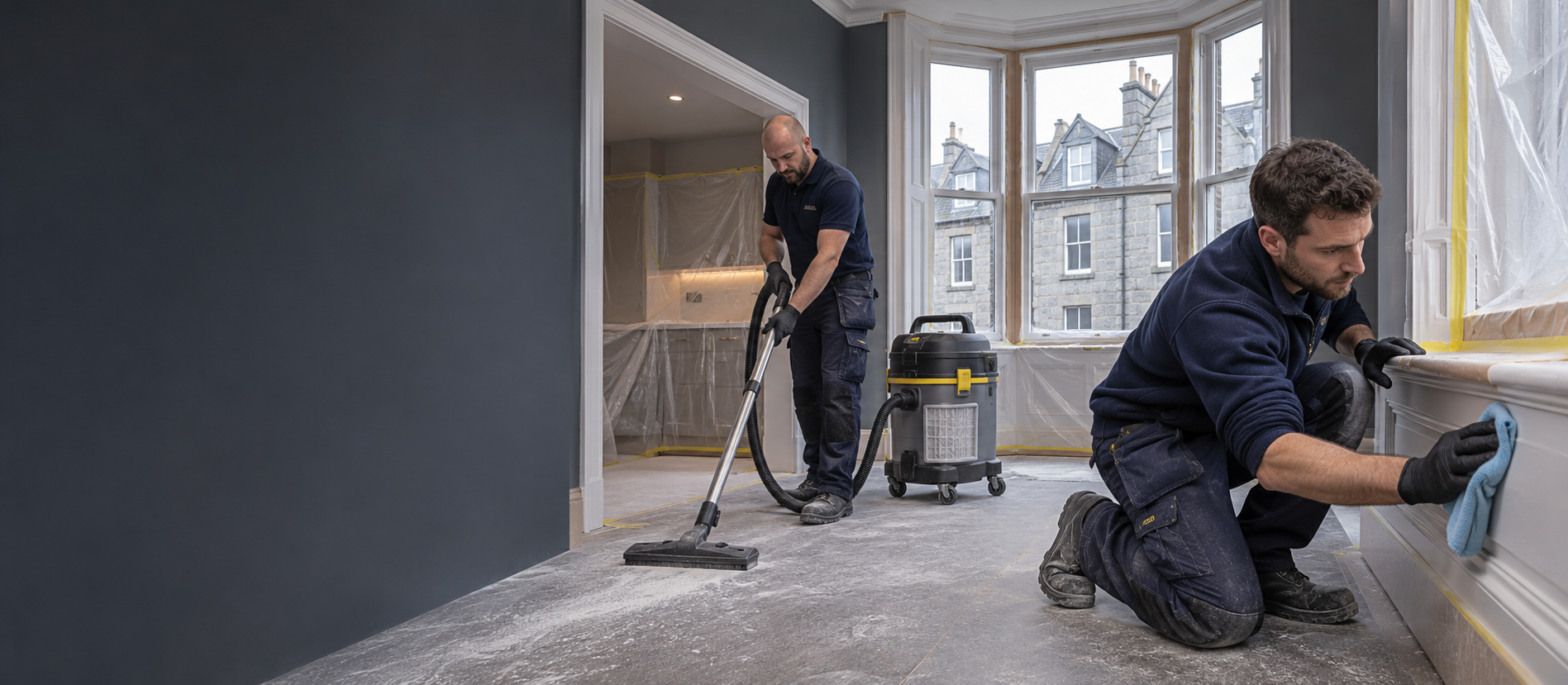
After builders cleaning in Aberdeen and Aberdeenshire
When a renovation team leaves, the rooms may look finished from the doorway while fine dust still settles on shelves, window tracks, skirting boards and freshly installed fittings. Nova Clean Aberdeen plans after builders cleaning for homes, offices, shops and managed properties where the last stage before occupation needs more care than an ordinary domestic clean. We discuss the trades involved, the state of completion, the new materials and the handover date before defining the cleaning scope. A newly painted room, a replaced bathroom and a whole-house refurbishment each bring different residues and different surfaces to protect.
Enquiries come from Aberdeen city centre, Rosemount, Ferryhill, Torry, Bridge of Don, Dyce, Cove Bay and nearby communities including Westhill, Portlethen, Stonehaven, Inverurie and Ellon. A granite tenement may have narrow shared stairs and sensitive older joinery, while a modern office may have large glazed areas, raised floors and access hours set by building management. We confirm the route for equipment, working utilities and any restrictions before suggesting a visit or quotation.
Agree the moment when construction is ready for cleaning
Cleaning too early often means paying to remove the same dust twice. Ask the principal contractor whether sanding, cutting, drilling, snagging and final painting have finished, whether protective films can be removed and whether tools and waste will be cleared. A room still being worked on may need an interim clean for safe access followed by a final handover clean. The two stages should be identified separately. We also ask who is responsible for disposing of offcuts, packaging and construction waste, which are not automatically part of a cleaning quotation.
The completion schedule matters. If a flooring installer returns after the first visit, the floor may need a final clean once adhesive or dust generation is over. New silicone and sealants may require curing time before nearby surfaces are washed. We will not scrape a fresh finish or remove a manufacturer label without instruction. A contact who knows what has been installed helps the cleaning team distinguish temporary protection from a finished surface.
Fine dust moves beyond the visibly worked area
Plaster, sawdust, tile cutting residue and sanding powder can travel under doors and settle in rooms that were not renovated. Even when a contractor has used sheeting, dust may collect on door tops, ventilation grilles, light fittings, picture rails, cupboards and soft furnishings. We ask which rooms were occupied during the work and where materials were cut. The inspection should include adjacent halls and common access routes, not only the room shown in photographs.
Appropriate filtration and a top-to-bottom sequence help reduce repeated settling. Loose dust is removed before damp wiping so it is less likely to turn into a film or scratch a finish. Work moves across accessible high surfaces, joinery, fittings, cupboards and then floors. A final pass may be appropriate after the air has settled. We explain which areas are accessible without dismantling and whether a specialist contractor must inspect ventilation or concealed voids.
Protect new paint, timber and decorative finishes
A freshly painted wall can mark easily, and a newly oiled timber floor cannot be treated like an older sealed vinyl surface. Before cleaning, we ask for any manufacturer guidance or contractor care instructions. We identify the finish on cabinets, countertops, stone, metal, glass and flooring. An inconspicuous test can be useful where adhesive marks or protective film residue need treatment. We do not assume that an aggressive scraper or stronger chemical will improve the result.
Traditional Aberdeen properties may combine original sash windows, cornices, granite details and new joinery within the same room. Dust in fine mouldings requires patience, while old paint can be fragile. New tiles can carry grout haze, but the tile and grout type determine the method. Natural stone can be especially sensitive to acidic products. If a defect appears to be a trade issue rather than removable residue, we record it for the owner or contractor instead of trying to polish or scrub it away.
Kitchens, bathrooms and fittings need a room-specific checklist
Kitchen handovers often involve cabinet interiors, shelves, worktops, splashbacks, appliance exteriors and accessible spaces around fixtures. We ask whether drawers and cupboards may be opened and whether appliances have been installed and connected. Stickers, silicone smears and adhesive marks can require careful testing. Cleaning does not include electrical commissioning, appliance repair or removal of materials that the contractor has not authorised us to touch. A clear list prevents the owner from assuming that every inaccessible gap has been reached.
Bathrooms may contain grout residue, dust inside vanity units, marks on shower screens and debris around sanitary fittings. We consider the curing state of sealants, the finish on taps and the condition of new stone or ceramic. Excessive moisture can affect fresh grout or unfinished timber. Where a leak, poor seal or drainage defect is noticed, we report it; cleaning will not repair it. The aim is a useful handover, not a visual cover-up of outstanding construction work.
Windows, tracks, frames and exterior access
Glazing can hold fine paint mist, sticker residue or dust from cutting and fitting. Frames and tracks often collect debris that is easy to miss when the glass looks clear. We ask whether the job includes interior glass only, accessible exterior glass or specialist high-level access. In a tenement, exterior windows above a pavement or courtyard require a separate safe access assessment. We do not include elevated work by default simply because a window appears in the room schedule.
Freshly fitted frames, coated glass and older sash units can be scratched by unsuitable blades or abrasive pads. We identify the type of mark and test a compatible method where needed. If a mark is trapped within a sealed unit or is a defect in the glazing, further cleaning will not remove it. This distinction is useful at a contractor handover because it directs attention to the trade responsible for the finish.
Floors need the correct final treatment
A floor can be the largest visible surface and the easiest to damage. Fine particles beneath shoes or a mop can abrade a new finish. We first remove loose debris and dust, then select a method for the actual material: timber, laminate, vinyl, ceramic, carpet or stone. Some newly laid coverings have restrictions on moisture, chemicals or mechanical equipment. We ask for those instructions before work begins and avoid using a single product across all rooms.
Carpets may contain construction dust deep in the pile, but extraction is not automatically appropriate immediately after installation. Adhesives, underlay and backing should be considered. Timber and engineered boards may need only a compatible low-moisture clean rather than aggressive polishing. Grout haze on tiles needs a material-specific response. If a permanent scratch, burn or adhesive defect is exposed after dust removal, we note it so that a decision can be made about repair.
Commercial and managed-property handovers
An office refurbishment may include meeting rooms, washrooms, glazed partitions, lift lobbies and shared corridors. We ask who controls access, which areas must remain open and whether cleaning must take place outside operating hours. A shop may have fixtures, stock and display surfaces requiring protection. In a managed block, the owner may instruct cleaning within one unit while a separate party controls the common stair. We clarify these boundaries before quoting.
A phased handover may be more practical than waiting for every trade to leave an entire building. In that case, each zone needs an agreed completion point, a route for equipment and a record of what was cleaned. If new work then disturbs a completed area, a further clean is a change to the scope. We can plan an efficient sequence, but we cannot prevent dust from a continuing construction process from returning.
What shapes the price and duration
The cost depends on the floor area, number of rooms, amount and type of dust, adhesive residues, glass and fittings, access, stairs, working utilities and the deadline. A nearly complete flat with light residual dust differs from a property where construction waste, heavy plaster deposits and unfinished trades remain. A site visit or photographs may be needed to understand the difference. A quote should describe what is included rather than relying on the number of bedrooms alone.
We ask whether waste removal, exterior glass, high-level surfaces, carpet extraction, appliances and communal areas are required. If the contractor will be present, we need a plan for safe movement and the timing of noisy or dusty tasks. Extra work discovered behind fixtures or after protection is removed should be discussed before it is added. This gives a property owner or project manager a realistic basis for approval.
Containment and safe working around an occupied property
Some homes remain occupied during renovation. In that situation, a cleaner needs to know which rooms are in use, where children or pets may be present and whether a temporary route can be maintained. Dusty equipment should not be moved through an occupied sitting room without a plan. Doors, thresholds and shared corridors can be protected where appropriate, and the team should agree where bags or equipment may be placed. We discuss whether the household can avoid active work areas and when cleaned rooms will be available again.
Workers should not disturb unknown insulation, suspect older coatings or damaged electrical installations. If a material may require specialist assessment, the relevant trade or surveyor must address it before cleaning proceeds there. A post-construction clean removes accessible residues; it is not a substitute for inspection of the building work. This distinction protects the owner from treating a cosmetic finish as evidence that hidden services are complete.
Recording outstanding defects and keeping the handover useful
Cleaning often reveals marks that dust previously concealed. A chip in a tile, paint on a hinge, a scratch in glass or uneven sealant may be a snag for the contractor. We can flag these observations to the authorised contact rather than treating every mark as a cleaning failure. A final walkthrough should compare the result with the agreed room list, identify inaccessible areas and note materials left for another trade. If an item cannot be cleaned safely without specialist instructions, that limitation should be written down.
For a landlord, managing agent or commercial occupier, a record of scope and completion helps distinguish the cleaner's work from the contractor's own finishing obligations. It also makes a return visit easier to plan if further trades create new dust. We recommend deciding in advance who signs off the cleaning and whether keys, access cards or alarm arrangements change at handover. Clear communication is especially valuable when several parties coordinate a property in Aberdeen from different locations.
Keeping a newly cleaned property in good condition
Once cleaning is complete, avoid bringing unprotected construction materials through finished rooms. If furniture arrives immediately, allow space for the final inspection of floors and skirting boards first. New painted or sealed surfaces should be maintained according to the finish manufacturer's guidance, and the owner should keep care information supplied by the contractor. If airborne dust continues to settle after repeated cleaning, investigate whether an active source remains in a ventilation route or an unfinished area rather than simply washing the same surfaces again.
How to prepare your Aberdeen cleaning enquiry
Send the postcode, property type, approximate floor area, rooms renovated, planned completion date and a short list of new surfaces. Tell us what remains unfinished, whether power and water are available, how to access the property and who can approve removal of protective materials. Photos of representative rooms and difficult marks are useful when taken safely. Mention any conservation features, manufacturer cleaning instructions and areas that must remain untouched.
Call 0845 52 805 20, email