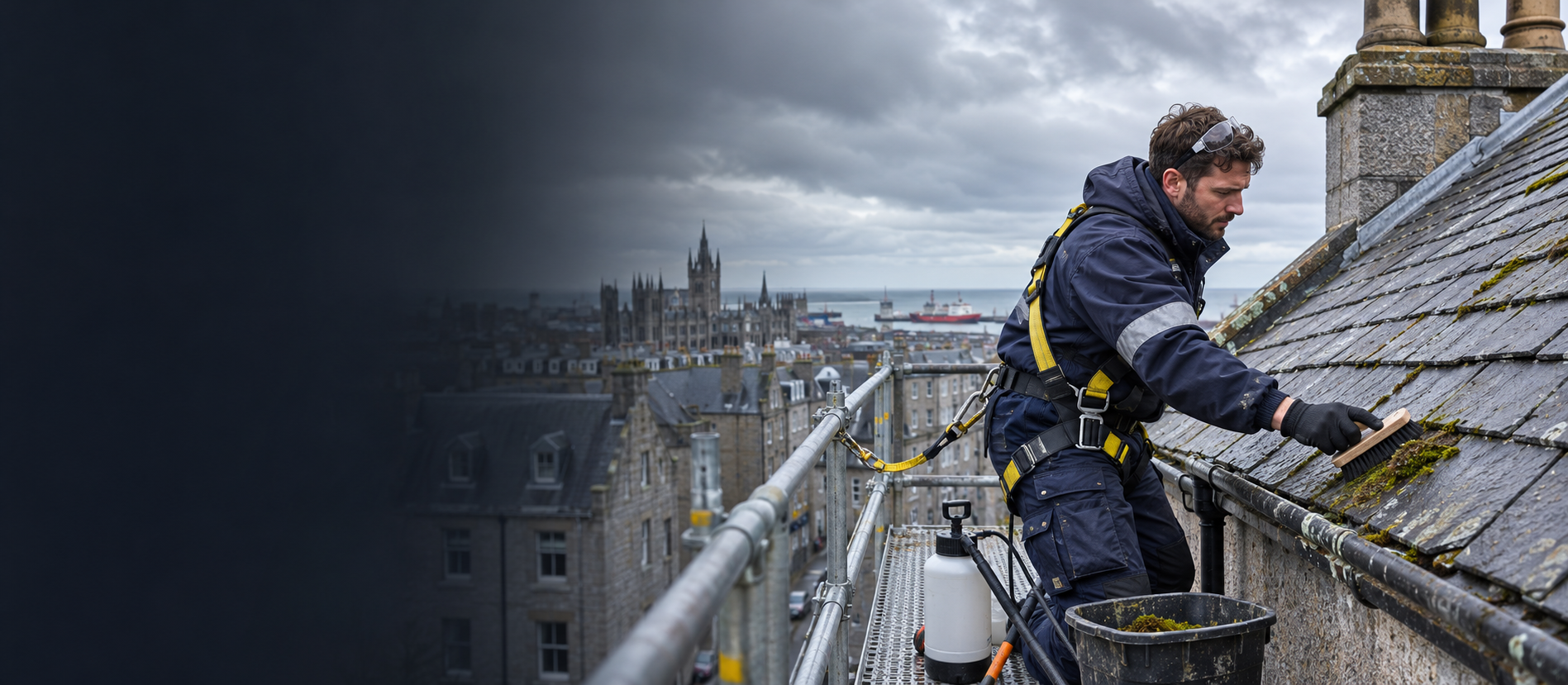
Roof cleaning in Aberdeen and Aberdeenshire
Roofs in the north east face wind-driven rain, salt carried inland from the coast and long periods of damp weather. Moss and organic growth may retain moisture around tiles, slates, gutters and shaded valleys, but their presence alone does not justify an aggressive wash. Nova Clean Aberdeen begins with the covering, its condition and a practical access plan. Homes in Bridge of Don or Cove Bay, granite buildings near the city centre and commercial roofs around Dyce or Westhill can call for very different methods.
Inspect the roof before choosing a cleaning method
Tell us the roof type, approximate age, pitch, number of storeys and any known leaks or fragile areas. Photographs from the ground can show broad coverage, but a safe close inspection may be needed to confirm cracked slates, loose ridges or vulnerable coatings. A roof with defective flashings needs repair advice from a roofer before cleaning creates further exposure. We distinguish removing growth from repairing a covering, clearing gutters or treating structural dampness.
Uncontrolled pressure can drive water under overlapping materials, dislodge older surfaces and scatter debris over neighbours or gardens. A suitable approach might involve careful manual removal in accessible zones, controlled low-pressure treatment where compatible, or a different method after a trial. The decision depends on manufacturer guidance, the substrate and the condition observed. We will not promise a uniform colour where age and weathering have changed the surface itself.
Protect people, planting and drainage
Work at height requires a suitable means of access and a plan for fall protection. A ladder alone may be inadequate for a large or steep roof. We ask about the position of conservatories, extensions, public paths, neighbouring properties, overhead cables and solar panels. Debris collection and protection of gardens or drainage should be considered in the quotation. Occupants may need to keep windows closed and avoid affected outdoor areas while work proceeds.
Growth can return where shade, moisture and blocked drainage remain. A follow-up maintenance plan should focus on gutters, overhanging vegetation and periodic inspection rather than a promise that moss will never come back. Chemical treatments, if considered, must be compatible with the covering and surrounding environment. Any treatment scope and limitations should be stated clearly.
Slate, tile and modern roof systems do not tolerate the same process
Natural slate is common in older Aberdeen streets, while later houses may have concrete or clay tiles, metal components, flat roof membranes and roof lights. The surface material is only part of the assessment. Fixings, underlay, pointing and prior repairs can be fragile even when the visible covering looks sound from below. Manual work on one slope may be sensible, while another area may be inaccessible without scaffolding. We ask for information about prior leaks or insurance repairs because water introduced during cleaning could expose a defect that already exists.
A newer coated tile can lose colour if treated abrasively. Old slate can split when stepped on, and a flat membrane can be punctured by unsuitable tools. These are reasons to avoid a universal roof cleaning package. We may recommend that a qualified roofer inspects defects or carries out repairs before the cleaning plan is finalised. Photographs and a visit can distinguish removable moss from staining or worn surface material. A clean does not make a roof watertight or extend a manufacturer's warranty by itself.
Moss, lichen and the limits of a visual result
Moss can grow where moisture is retained in shade, at overlaps and near gutter lines. Lichen bonds more firmly and may leave a mark when removed. The amount of growth matters, but so does its position. A patch over an intact tile may be an appearance issue, while debris at a valley or outlet could affect drainage. We look at the whole roof and the route taken by rainwater rather than selling a treatment on the basis of colour alone.
Hand removal can reduce bulk in reachable areas, followed by an appropriate surface treatment where the roof material and surrounding environment allow it. Results may change gradually rather than immediately; a roof is not necessarily returned to a uniform original shade. We explain what can be reasonably expected from the proposed method, whether gutters must be cleared afterwards and what happens to loosened growth. Scraping without collection can simply move the problem to a downpipe or a neighbouring property.
Gutters, downpipes and the route of runoff
Debris from a roof can enter gutters, outlets and drainage. We identify whether gutter clearing is included and whether a full drainage inspection is beyond scope. A blocked downpipe may need separate investigation, especially if there is already damp staining on the building. Cleaning a roof while leaving a gutter packed with moss can undermine the value of the work. Conversely, a gutter problem alone may not justify treating the entire roof. A clear quotation separates these tasks.
Water and any treatment product should be managed so that it does not wash unchecked over planting, vehicles, neighbouring windows or the public pavement. A garden with a pond or sensitive planting needs particular consideration. Weather and wind direction affect the schedule on an exposed Aberdeen property. A team may defer work if conditions do not permit safe access or controlled application. This is a practical safety decision, not a failure of the cleaning plan.
Access equipment and working at height
A ground-level view can underestimate the pitch, hidden valleys and distance to a roof edge. The safe method may involve a scaffold, mobile platform, appropriate roof access system or another planned arrangement. The choice depends on height, layout, ground conditions and how long the team must work. A conservatory or extension below a slope complicates access because it cannot be treated as a load-bearing platform. We ask about power lines, skylights, fragile areas and points where people pass beneath.
Commercial roofs bring additional questions: roof permits, fragile panels, plant equipment, site induction and coordination with the building manager. Work near solar arrays requires attention to electrical boundaries and the mounting system. If the panels themselves need cleaning, see our solar panel cleaning service; it has a separate compatibility and access assessment. The two tasks can be discussed together, but they should remain distinct in the scope and price.
Historic roofs and managed properties
A tenement, church hall or converted granite building may have shared ownership, conservation considerations and limited access from the street. We ask who can authorise work and whether a factor manages the roof. Neighbours may need notice if protection or access equipment affects shared areas. The team should know whether the owner has drawings, previous inspection reports or records of replacement slates. Cleaning must respect the condition of the historic fabric, and significant repairs should be referred to competent trades.
For a rental or managed property, record the reason for the request. Is the concern blocked drainage, material falling to the ground, visible growth, or preparation for a roof inspection? The desired outcome determines the method and prevents a cosmetic request from obscuring an urgent defect. We can provide a cleaning scope and report what is visible during work, without claiming to perform a structural survey.
How to prepare the property and compare proposals
Send photographs from each safe vantage point, including the entire slope, gutters, extensions and the ground where access equipment could stand. Do not climb onto a roof to obtain close-ups. Tell us about leaks, loose tiles, prior coatings, nearby trees and the dates when work is possible. Check whether the contractor's proposal names the roof material, the access method, debris collection, gutter work and any treatment to be applied. A low price that omits safe access or waste handling may not describe the same service.
After cleaning, consider a maintenance plan that keeps outlets clear and addresses branches or building defects contributing to growth. The timing of regrowth depends on shade, exposure and moisture. There is no honest guarantee that a roof will remain clear indefinitely. If bird deposits are the primary concern rather than moss, our pigeon guano removal service focuses on controlled collection and contamination.
Roof cleaning enquiries across the north east
We discuss roofs in Aberdeen neighbourhoods including Rosemount, Ferryhill, Torry, Bridge of Don, Dyce, Cove Bay and Cults, and in nearby towns such as Westhill, Portlethen, Stonehaven and Inverurie. Coastal exposure, roof age and access differ even within one street. An exact postcode and photographs help us assess travel and whether an on-site visit is needed. For a larger commercial roof, give the site's working hours, access contact and any permit process.
Where a roof is part of a broader exterior project, it may be useful to coordinate with facade cleaning so runoff and access are planned in the right sequence. We still define each surface separately. Tell us whether the principal goal is growth removal, a safer gutter line, an appearance improvement or preparation for maintenance. That allows a proposal to state its limits clearly.
Distinguish cleaning from repair and roof maintenance
A roof can look dirty because of moss, algae, salt film or ordinary weathering, but a patch of damp on the ceiling may indicate a separate defect. Cleaning personnel can observe missing tiles, displaced flashing or blocked drainage from safe access, yet they should not claim a roof is watertight after washing it. We ask the owner to describe known leaks and arrange a roofing assessment where necessary. The cleaning quotation should say whether accessible gutter debris is included and what remains the responsibility of a roofer.
Fragile coverings and old fixings can change the method or make cleaning inappropriate. A test area can show whether a visible mark is removable without stripping the surface. The aim is to preserve the roof material and its function, not to force every tile or slate to appear identical. A strong jet can drive water under laps or dislodge weakened sections. We choose a controlled process from the condition observed rather than an attractive before-and-after promise.
Plan for wind, rain and the ground below
Aberdeen's weather can make roof access unsafe even when the day begins dry. Wind affects ladders, platforms and the movement of debris. A date may need to change when conditions are unsuitable. We discuss where loosened moss and rinse water will go, and protect entrances, cars, planting and neighbouring property beneath the work. Downpipes should not be overwhelmed or blocked by material pushed from the roof. A responsible sequence includes collection and a check of accessible drainage after treatment.
On a terrace or attached property, an upper slope may shed onto a lower roof, conservatory or shared walkway. We ask for photographs of each elevation and the route of runoff. The owner or manager can notify neighbours if an access zone affects them. A quotation that includes only roof surface treatment should not silently imply cleaning all adjoining façades, windows and solar panels. Those tasks can be coordinated but need their own method and scope.
Record the condition and choose a sensible interval
Before work, photographs of representative slopes, ridge details and known defects provide a useful reference. After work, the client can compare accessible areas and note any persistent staining, fragile covering or blocked section that needs another trade. Biological growth may return according to shade, moisture and roof design. A cleaning visit does not guarantee that a covering stays free of growth for a fixed period. We can discuss practical maintenance observations, including overhanging vegetation and drainage, without recommending unnecessary repeat treatment.
For a commercial building, the facilities manager may need a method statement, access schedule and isolation of areas below. For a home, parking and garden access may be the main constraints. Both deserve a proposal that identifies the actual covering, agreed areas, safe reach, waste handling and any limits. This makes the result reviewable and avoids using a generic process on a roof whose construction needs greater care.
Request a roof assessment
Send the Aberdeen or Aberdeenshire postcode, building type, images of each elevation and roof slope, access restrictions and your main concern. Explain whether you need gutter clearance or a solar panel inspection as a separate item. We can identify whether a survey is necessary and what a proposal would include. Email