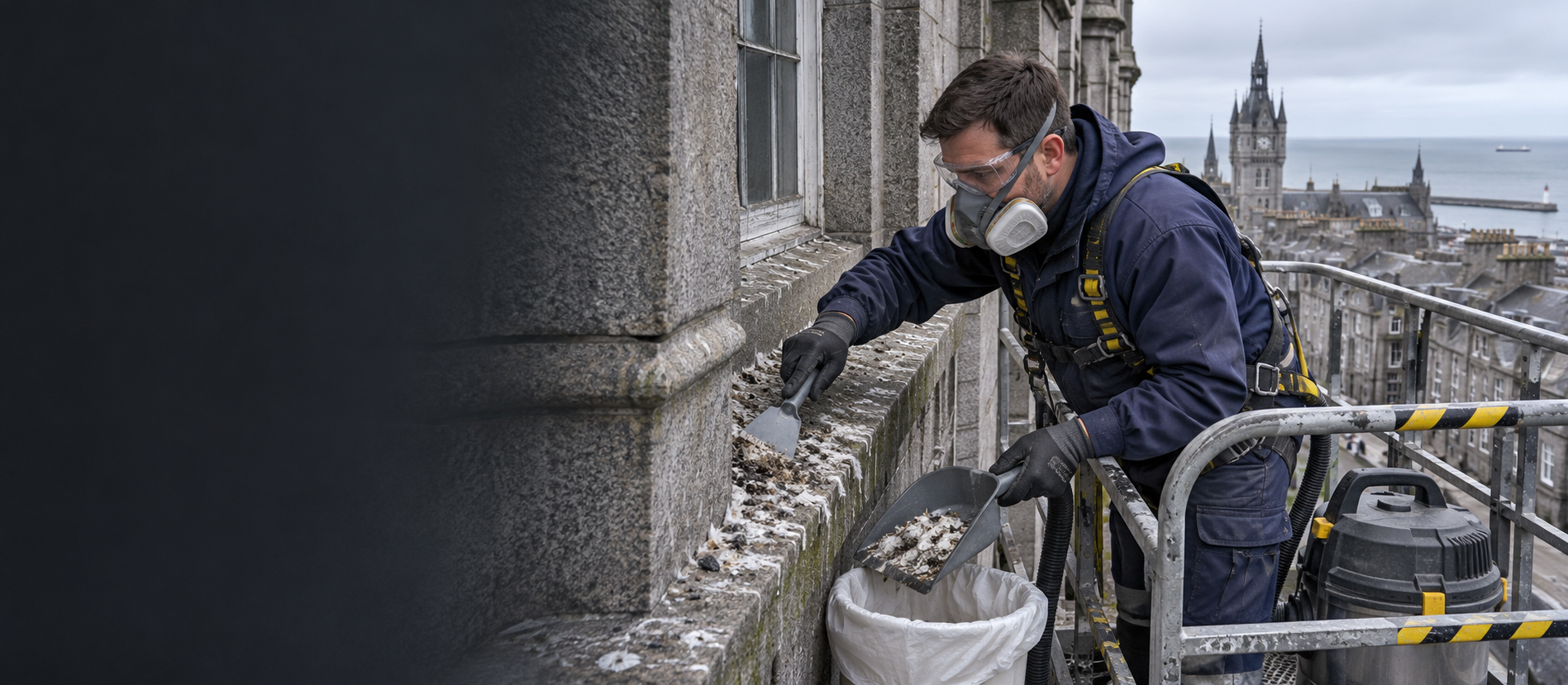
Pigeon guano removal in Aberdeen and Aberdeenshire
Pigeon fouling can build up quietly on a sheltered balcony, roof edge, loading bay or plant enclosure before anyone has safe access to it. In Aberdeen, exposed façades and coastal weather add another complication: rain can carry deposits across stonework, while dry material may break apart when disturbed. Nova Clean Aberdeen discusses controlled cleaning of affected areas, the access route and the condition of the surface before a team is assigned. Our local enquiries include city centre blocks, Torry warehouses, Bridge of Don premises, Dyce business properties and homes toward Westhill and Portlethen.
Assess the fouling and the route to it
We ask for photographs showing both the affected area and the approach to it. A fourth-floor ledge above a public pavement calls for a different plan from a ground-level balcony with a washable floor. Describe loose debris, nesting material, blocked gutters, air intakes, occupants below and any damaged finish. If a roof is involved, identify its material and known fragile areas. The property manager or owner should confirm access rights and any working-hour restrictions before work is scheduled.
Older deposits may be compacted or have soaked into porous surfaces. Aggressive scraping can damage coatings and throw material into occupied spaces. A careful assessment considers containment, how to collect residue, suitable protective clothing and how to keep others away from the working zone. We avoid promising that every stain can be removed without first examining the substrate. A small inconspicuous trial can be useful on sensitive finishes.
Controlled cleaning, collection and disposal
The team plans the sequence so loose material is collected before wet cleaning, with precautions appropriate to the condition and location. Dry brushing or uncontrolled pressure washing can spread particles or move contamination into neighbouring property and drainage. Equipment and cleaning solution are selected for the surface. Interior lofts and enclosed plant rooms may need additional attention to dust control and ventilation. Collection and disposal are assessed separately from washing because volume and access change the labour involved.
Cleaning may reveal loose flashing, decayed timber, blocked outlets or defects that need a roofer or another trade. Removal of deposits does not repair the underlying building. Bird proofing is also a separate decision: deterrent systems must suit the building and avoid trapping animals. If birds continue to roost, fresh contamination can return quickly, so tell us whether you also need an assessment of recurrence.
Balconies, ledges and shared entrances need different controls
A balcony used by residents is a small space with immediate contact points: a handrail, door threshold, floor finish, drainage outlet and furniture may all be affected. Before work, remove movable personal items if this can be done safely and tell us whether the balcony is above another home or a public route. Water used without containment can carry residue onto a neighbour's windows or into a downpipe. An exposed granite ledge may tolerate a different treatment from a painted metal balustrade or coated composite decking. We identify each material and the route for removing collected material.
In an apartment block, a factor or managing agent may have to authorise access to the roof or common parts. The team may need to coordinate with residents about a temporary exclusion area, especially when a ledge lies above an entrance. A narrow internal staircase or a window that does not open sufficiently can rule out an apparently simple approach. We never assume a photograph taken from ground level proves that a working position is safe. The practical access plan can be a significant part of the quotation.
Commercial loading bays and rooftop plant
Birds can perch above loading doors, roller shutters, warehouse beams and mechanical equipment. In those settings, cleaning has to fit around deliveries and the movement of staff. A cordon should prevent people from passing beneath work while deposits are disturbed. Vehicles, stored goods and air handling equipment may need covering or temporary relocation. If an air intake has drawn contamination inside, the operator should have its system assessed separately; washing the outer casing alone does not establish the condition of internal ductwork.
Plant rooms and roof installations often include live electrical equipment, fragile roof coverings and trip hazards. We ask for an authorised site contact and information about isolation procedures, roof permits and access points. Cleaning technicians can treat accessible surfaces under a defined method, while repairs, electrical work and changes to bird deterrence remain separate tasks. A property with recurring fouling may benefit from a coordinated inspection that addresses the reason birds return after the initial clean.
Porous stone and delicate building fabric
Aberdeen's granite is durable, but joints, repairs, adjacent paint and metal fixings can be less forgiving. Deposits may leave discolouration even after the loose material has been removed. On sandstone, render and older painted surfaces, the risk of abrasion or water ingress may be greater. We discuss a test area and a measured method rather than treating every façade with the same pressure. A high-pressure jet can drive contaminated water into joints, damage coatings or carry residue over a much larger area. The same caution applies to historic details and narrow window reveals.
Roofs present their own limits. Tiles, slates, roof lights and gutters can be damaged by traffic or unsuitable equipment. A cleaning proposal should explain where the team can work from, whether access equipment is needed and what is excluded. If the roof covering is visibly deteriorated, a competent roofing assessment may be needed first. Our roof cleaning service deals with the broader surface condition, whereas guano removal focuses on the contamination and its safe collection.
Health precautions without overstating what cleaning can do
Bird deposits and nesting material should be handled with controls proportionate to volume, dryness, location and occupancy. The aim is to avoid dispersing dust and transferring residue to clean spaces. Technicians may need suitable protective equipment, hand hygiene arrangements, covered collection and a planned route for taking waste away. The exact method depends on a site assessment. An ordinary vacuum, dry broom or unrestricted pressure wash can spread material rather than control it.
Cleaning and disinfection have different purposes. Physical removal of visible deposits comes first; any subsequent product should suit the surface and be applied according to its instructions. A disinfectant cannot reliably penetrate a heavy layer of dirt, and a strong smell does not prove that an area has been made safe. We do not promise permanent sterilisation or that birds will stop returning after a single visit. Occupants should be kept away from the working area until the agreed cleaning and handover checks are complete.
Waste, nesting material and responsible boundaries
The quantity collected may range from a small bag of loose debris to substantial accumulated material in a sheltered void. We need enough information to plan packaging, movement through the building and an appropriate disposal route. If the area contains needles, general fly-tipping, asbestos suspect material or other unrelated hazards, stop and disclose that before a cleaning team is booked. Those conditions change the assessment. We also ask whether there are active birds or nesting activity; work should not proceed in a way that disregards wildlife obligations or creates avoidable harm. A relevant specialist can advise on lawful exclusion or proofing where necessary.
Where a building is managed, keep a record of the affected areas and any recurring defects that allowed deposits to accumulate. Cleaning can restore access and improve the surface condition, while a maintenance plan may address broken mesh, failed gutters or sheltered roosting points. These items should be separated in the quotation so the person approving the work can see exactly what is being delivered.
Preparing an Aberdeen property for the visit
Photograph the area from a safe position and include something that gives a sense of scale. Do not climb onto a roof or lean out of a window to obtain close-up images. Send the property type, postcode, floor level, access arrangements and details of people or goods immediately below. Explain whether the area must remain in use and whether the contamination affects a balcony, roof, façade, plant enclosure or several locations. For commercial premises, give the site contact, operating hours and any permit requirements.
We cover enquiries across Aberdeen, from the city centre and harbour to Rosemount, Torry, Bridge of Don, Altens and Dyce, and in nearby towns such as Westhill, Portlethen, Stonehaven and Inverurie. Travel, equipment and permissions vary by address. For work on a wider building exterior, the facade cleaning service may also be relevant. Tell us whether you want only the contaminated patch treated or a broader appearance assessment, since the latter should be priced separately.
Agree the boundary between cleaning and bird proofing
Removing deposits can improve a ledge or balcony, but birds may return if the reason they settle there remains. We ask whether the owner has permission to install any deterrent and whether a separate specialist has assessed the building. Cleaning should not be sold as a permanent exclusion measure. Nets, spikes, access repairs and changes to a roof detail belong to a different specification. Where a nest or active bird activity is present, work may need to be delayed or planned with appropriate advice and the applicable rules in mind. The quotation should state exactly what will be collected and cleaned.
On a shared building, the source may be above the area first noticed by a resident. Fouling can run from an upper ledge onto a lower balcony or entrance. We ask for photographs of the elevations and a view of where birds perch. Treating only the floor below can leave the source untouched. The manager can then decide whether a building-wide assessment is useful, with cleaning zones and future proofing considered separately.
Control dust and access in occupied spaces
Dried deposits should not be disturbed casually with a household brush or an unplanned jet of water. We consider how to isolate the work area, protect people beneath it and collect material without spreading it to neighbouring windows, ventilation intakes or paths. A high-level ledge may require a platform, while a narrow balcony may be reached from inside only after furniture is moved. If the route passes through an occupied room, protection and a safe handover become part of the plan. We explain the method in proportion to the actual volume and location of deposits.
Staff should not work over an open public entrance without a controlled zone. On a loading bay, deliveries may need to pause for an agreed period. Drainage and runoff require attention if a wet method is suitable; residue should not simply be washed into an unknown outlet. We ask about surface material because rough granite, paint, metal and glass can each retain deposits differently. A small trial can clarify the likely visual result on a delicate finish.
Make the handover clear for the property owner
Before photographs can show the affected area and any existing corrosion, worn coating or cracked mortar. After cleaning, we can record which reachable surfaces were treated, whether a stain remains in a porous material and whether access prevented work elsewhere. A request for disinfection should be described precisely, including compatible surfaces and the chosen process, rather than implied by the word clean. Repairs to damaged fabric and decisions about future bird management remain outside the cleaning scope unless specifically arranged.
For a private balcony, the owner may also need general terrace cleaning after the contaminated material has been handled. For a commercial roof or plant area, a facilities contact should review access and equipment restrictions. The best proposal distinguishes contaminated material collection, surface cleaning, waste handling and any further work so that the result can be checked without unrealistic promises.
What helps us prepare an accurate quote
Send the Aberdeen or Aberdeenshire postcode, photos, the number and size of affected surfaces, the approximate height, the available access and the outcome required. Mention balconies used by residents, food preparation nearby or machinery that needs protection. We will clarify what can be cleaned, what needs specialist access and any limits due to delicate materials. For a discreet discussion, call 0845 52 805 20 or email