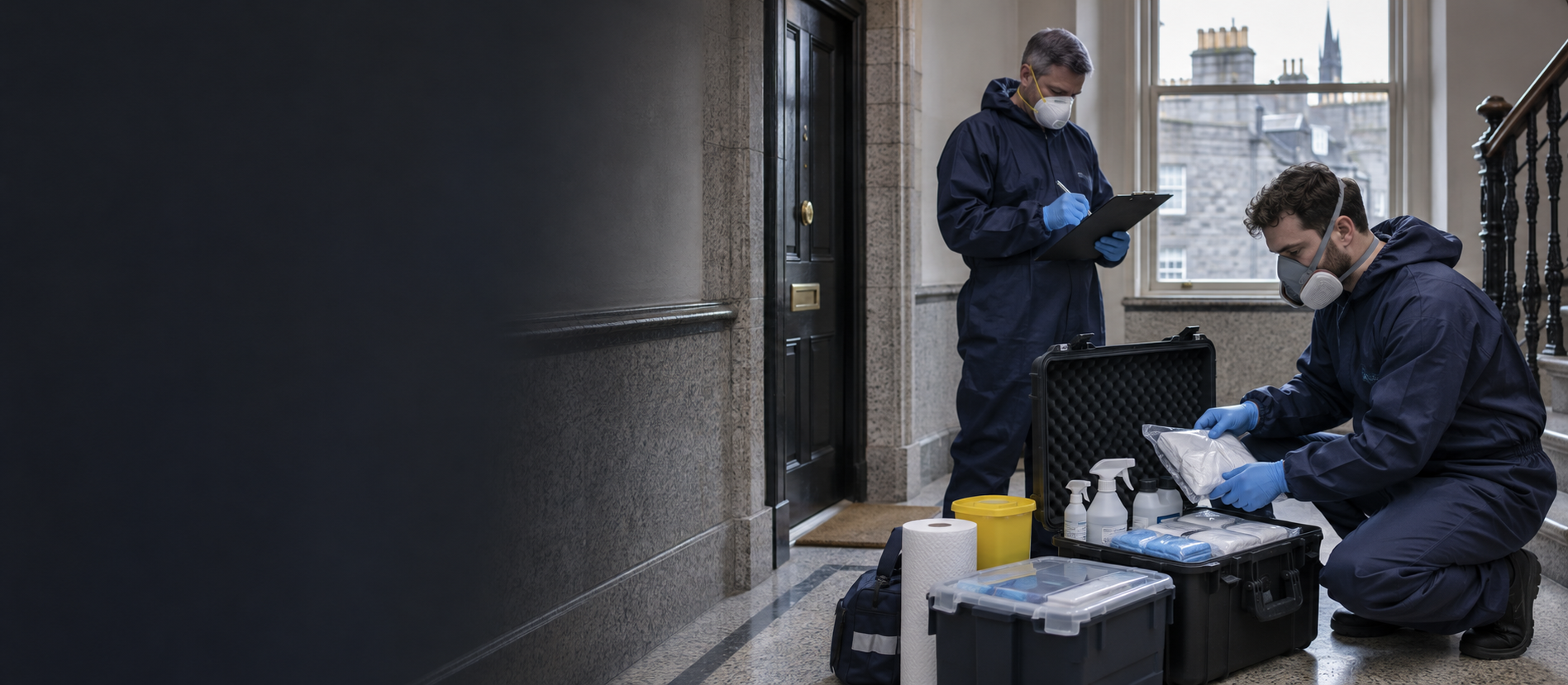
After death cleaning in Aberdeen and Aberdeenshire
When someone has died in a property, relatives, landlords and managing agents can be left with a practical task at a difficult time. The condition of the rooms may be uncertain, access may depend on an authority or an estate representative, and ordinary cleaning may be inappropriate. Nova Clean Aberdeen helps you establish a clear scope for specialist cleaning after a death, with discretion, controlled working methods and a plan that respects the property and the people connected to it. We discuss the circumstances in private, ask only for information needed to assess the work and explain the next steps before any visit is arranged.
Our enquiries come from flats and houses in Aberdeen city centre, Rosemount, Ferryhill, Torry, Bridge of Don, Dyce, Cults and Cove Bay, as well as properties in Westhill, Inverurie, Ellon, Banchory, Portlethen and Stonehaven. The distance, access arrangements and condition of each property affect scheduling. Please send the postcode so that we can confirm coverage and availability. The Nova Clean network was established in 2015 and coordinates specialist teams and partners for demanding one-off cleaning work.
What to do before cleaning begins in a home after a death
Before anyone enters a room to move belongings or wash surfaces, establish that the property has been released for access by the relevant people and that the person instructing the work is entitled to do so. If police or the Procurator Fiscal are involved, follow the instructions communicated about access and belongings before arranging cleaning. We do not decide who may enter or remove items. A family representative, executor, landlord or managing agent should identify the person who can approve the scope, provide keys and answer questions about contents that must be retained.
If the death was not discovered immediately, the affected area may involve fluids, damaged furnishings or persistent odour. Keep children, pets and unprotected visitors away from the area. Avoid moving visibly affected materials through shared corridors, spraying household fragrance over the source or mixing cleaning products. These actions can complicate assessment and spread contamination. Close the room when it is safe to do so and make a note of any urgent property issues such as a leak, electrical fault or broken window. If there is an immediate danger, use the appropriate emergency route before arranging cleaning.
A discreet assessment shaped by the actual condition of the property
A useful first conversation covers the address, property type, date of access, rooms involved, approximate time since discovery if known, and whether an authority has released the property. We ask about floor coverings, upholstered items, porous surfaces, heating and ventilation, and any visible fluid migration. Photographs can be helpful when they can be taken safely and lawfully, but we do not ask a relative to enter an unsafe room merely to photograph it. An inspection may be needed where the contamination is concealed, the building fabric is affected or the information available is incomplete.
We also ask whether there are adjoining flats, communal stairs, neighbours or a building manager to consider. In a granite tenement, a modern apartment or a detached house, access and waste movement can differ considerably. A team may need to protect common areas, plan a discreet arrival and arrange for keys to be held by a nominated contact. These details belong in the work plan because they influence time, equipment and the limits of a quotation.
How specialist cleaning is planned around affected materials
Work begins by identifying the affected zone and separating it from clean areas. Technicians choose protective equipment and a safe method of handling materials according to the observed condition, rather than relying on a single product for every property. Unaffected belongings are protected where possible. Items with sentimental or practical value are identified with the authorised contact before anything is discarded. The exact sequence can include controlled removal of irrecoverable material, cleaning of accessible hard surfaces, treatment of affected fixtures and a final check of the agreed area.
Porous materials need particular attention. A carpet, underlay, mattress, upholstered chair or unfinished timber may retain contamination below the visible surface. Cleaning the top alone cannot establish that the material is recoverable. Where fluids have reached a floor junction, skirting or subfloor, a more detailed inspection may be needed and building repairs may fall outside a cleaning assignment. We explain these distinctions in the proposal so that the client understands what can be cleaned, what may need removal and what requires another trade.
Disinfection follows cleaning of the relevant surface and must be matched to the material, the product directions and the conditions in which it is used. A label claim does not replace physical removal of soiling or justify using a product on an incompatible finish. The team records the agreed areas and any limitations encountered, such as inaccessible voids or materials that could not be retained. We do not promise that every odour or stain can be eliminated before the source and the substrate have been assessed.
Odour, ventilation and the limits of surface treatment
Persistent odour can come from material beneath a floor covering, in furniture, inside a porous lining or around an overlooked junction. Fragrance and general airing may temporarily change how a room smells without removing the source. The practical approach is to find and address affected material first, clean the surrounding surfaces and then consider whether further odour treatment is appropriate. Ventilation, temperature and the length of time a property has remained closed can influence the result. Any proposed specialist treatment should have a defined area, method and safety arrangements.
Some properties also have unrelated issues, such as mould after a long period without heating, food waste, pest activity or a blocked bathroom. We distinguish these from contamination associated with the death. Additional rooms or tasks should be agreed separately instead of being silently included in a single room quotation. This protects the client from an unclear price and gives the technicians enough time and equipment for the work actually needed.
Belongings, clearance and respectful handover
Cleaning and house clearance are different decisions. A relative may need time to locate documents, photographs, medication, keys or financial records before a room is cleared. We ask the authorised contact to set aside protected belongings and to explain how uncertain items should be handled. The team should not make personal decisions about what a family wishes to keep. If removal is requested, the proposal describes the areas, volume assumptions and handling route. Waste that needs specialist handling is assessed according to its condition and the arrangements available for lawful disposal.
A property manager may need a concise record of the work completed for a handover, while a family may prefer minimal contact after approving the scope. We can discuss the practical form of completion in advance, including photographs of finished areas where appropriate and authorised. The handover identifies any remaining limitations, such as an affected item awaiting a decision, a damaged floor that needs repair or an area that could not be reached safely. It should never imply that building work has been carried out when only cleaning was commissioned.
Quotations based on access, scope and material condition
The cost of after death cleaning depends on more than the size of a room. The number of affected surfaces, the amount of material to remove, access to the property, the time needed for careful segregation, waste arrangements and whether an inspection is necessary all matter. A flat with one contained hard-floor area can require a different plan from a house where fluids have reached carpet, furniture and the floor structure. We ask for a description of the condition before discussing a price. When an estimate is provisional, the reason and any decision point should be clear.
To help us prepare a useful response, send the postcode, the type and approximate size of the property, the number of rooms affected, whether keys are available, whether access has been released, and any known restrictions on waste movement or parking. Tell us if a landlord, insurer or estate representative needs a written scope. Do not share unnecessary medical details. If you have safe photographs, they can be discussed after the initial enquiry. We will explain whether a visit is appropriate and when a team may be available.
Preparing a coordinated visit when several people are involved
It is common for a property to have several contacts. A relative may live outside Aberdeenshire, a letting agent may hold the keys, and a factor or building manager may control access to a communal entrance. Before a visit, nominate one person to approve decisions about cleaning and one person to meet or admit the team. Share practical restrictions, such as lift access, parking, permitted working hours and whether water and electricity are available. If the property has been secured, explain whether a lock change has taken place. These details let the team plan a realistic arrival and avoid asking the family to repeat a difficult account to several people.
If an insurer or housing provider is involved, ask them what documentation they require and who will approve the cost. Our quotation can distinguish an initial contained clean from wider clearance or restoration if the full condition is not yet visible. Photographs, an inventory or a completion record may be possible within an agreed scope, but should be discussed before work starts. We cannot guarantee another organisation's acceptance of a claim or a particular reimbursement. The client remains able to decide which tasks are authorised and whether further work is needed after the affected area has been assessed.
Questions about shared buildings and neighbouring rooms
Aberdeen has many flats with shared stairs and close neighbouring properties. A team should consider the route from the affected room to the exit, protection of common flooring, how waste is contained and when residents might be using the stair. We ask whether any odour has been noticed beyond the flat and whether a neighbouring unit or common void is involved. That information helps define what can be inspected and prevents an assumption that cleaning one room will resolve a problem originating elsewhere. Access to adjoining property needs separate permission from the relevant person.
Within the home, rooms that seem unaffected may still require a careful visual check if doors were open or ventilation systems connected them. Equally, there is no reason to charge for treating an entire property solely because one room is affected. We agree boundaries before work, note surfaces that need further investigation and update the contact if the scope changes. This measured approach is especially useful in a tenanted flat where a landlord must decide between cleaning, replacement of damaged materials and separate building repairs.
What happens after the agreed cleaning is complete
At completion, the authorised contact should know which rooms were treated, what material was removed, whether any area remained inaccessible and what decisions remain. A persistent stain in an absorbent finish, damaged plaster or a source beneath fixed flooring may require a different trade or further inspection. We can explain the observed limitation without claiming to diagnose a building defect. A vacant property may also need ordinary maintenance, ventilation or repair before it can be occupied again. Those tasks should be arranged on their own merits rather than confused with the specialist clean.
Some families want to keep the property closed for a while; others need to prepare it for an estate handover, a landlord inspection or a sale. Tell us the intended next use so that we can discuss the appropriate level of finish. If a full house clean is requested beyond the affected area, identify that separately. A clear written scope helps everyone involved understand what has been done and what remains, while keeping communication respectful and proportionate to the situation.
Support across Aberdeen, the surrounding towns and rural addresses
We handle enquiries from Aberdeen neighbourhoods including Old Aberdeen, Kittybrewster, Mastrick, Kincorth, Bucksburn and Bridge of Don, as well as nearby communities such as Westhill, Kingswells, Portlethen, Stonehaven, Inverurie and Ellon. A rural address in Aberdeenshire may involve a longer journey and different access arrangements; the postcode allows us to confirm what is practical. Local property types range from upper-floor tenements with shared stairs to modern developments and detached homes, and the working plan must account for those differences.
Contact Nova Clean Aberdeen on 0845 52 805 20, email